
Processes
For procurement professionals sourcing aluminum components for high-performance applications—such as motorcycle structural parts, automotive suspensions, aerospace brackets, or professional hand tools—evaluating the optimal manufacturing process is a critical decision. The three primary manufacturing routes are Forging, Casting, and Full CNC Machining.
While each method has its distinct commercial and technical advantages, choosing the wrong manufacturing process can lead to unexpected structural failures, excessive machining costs, or weight penalties.
This guide breaks down the core differences in strength, structural integrity, and cost-efficiency to help sourcing managers choose the optimal process for their OEM projects.
1.Understanding the Three Core Manufacturing Processes
Aluminum Forging (Hot, Warm, and Cold Forging Capabilities)
Aluminum forging is a solid-state forming process that uses high-tonnage presses and specialized dies to shape metal through extreme pressure. Unlike casting, it does not melt the material; instead, it deforms the aluminum while it is solid, preserving and aligning its internal crystalline structure.
- The Secret to Strength — Continuous Grain Flow: The hallmark of any forged component is directional grain flow. Under pressure, the internal grains of the aluminum are forced to flow continuously and align with the 3D contour of the part. This eliminates internal weak points and results in superior tensile strength, fatigue resistance, and fracture toughness.
- Forging Temperature Classifications:
At Actionfast, we utilize different temperature ranges to achieve specific component performance and dimensional goals:
-
- Hot Forging: The material is heated above its recrystallization temperature (typically 350°C to 500°C for aluminum) before forming. This maximizes formability, making it ideal for large, complex, and highly stressed structural components.
- Warm Forging: Performed at intermediate temperatures below the recrystallization point. This process strikes a balance, offering better dimensional accuracy and surface finish than hot forging, while still allowing significant material deformation.
- Cold Forging: The material is formed at or near room temperature. While requiring much higher dynamic pressures, cold forging delivers the highest strength (due to work hardening), superior dimensional tolerances, and an exceptional, smooth surface finish that often eliminates the need for post-machining.
Aluminum Casting (Die Casting / Gravity Casting)
Aluminum casting involves pouring molten liquid aluminum into a mold cavity. As the molten metal cools, it solidifies into the desired shape.
- Key Advantage: Complex geometries and intricate internal cavities can be produced quickly and at a relatively low unit cost in high-volume runs.
- Key Limitation — Porosity: As molten metal solidifies, micro-porosity (tiny air bubbles) and internal shrinkage voids naturally form inside the casting. Under high dynamic loads or cyclical vibration, these micro-voids act as stress concentration points, increasing the risk of sudden structural failure.
Full CNC Machining
Full CNC machining involves cutting away material from a solid aluminum block using multi-axis CNC mills until the final shape is achieved.
- Key Advantage: Zero tooling/mold cost, making it ideal for low-volume prototyping or custom limited-edition parts.
- Key Limitation — Interrupted Grain Flow: Because the solid raw block has straight, parallel grain lines, cutting into the material severs the grain structure at sharp corners and thin walls, creating structural weak points compared to a forged part.
Table 1. Process Comparison: Forging vs. Casting vs. Full CNC
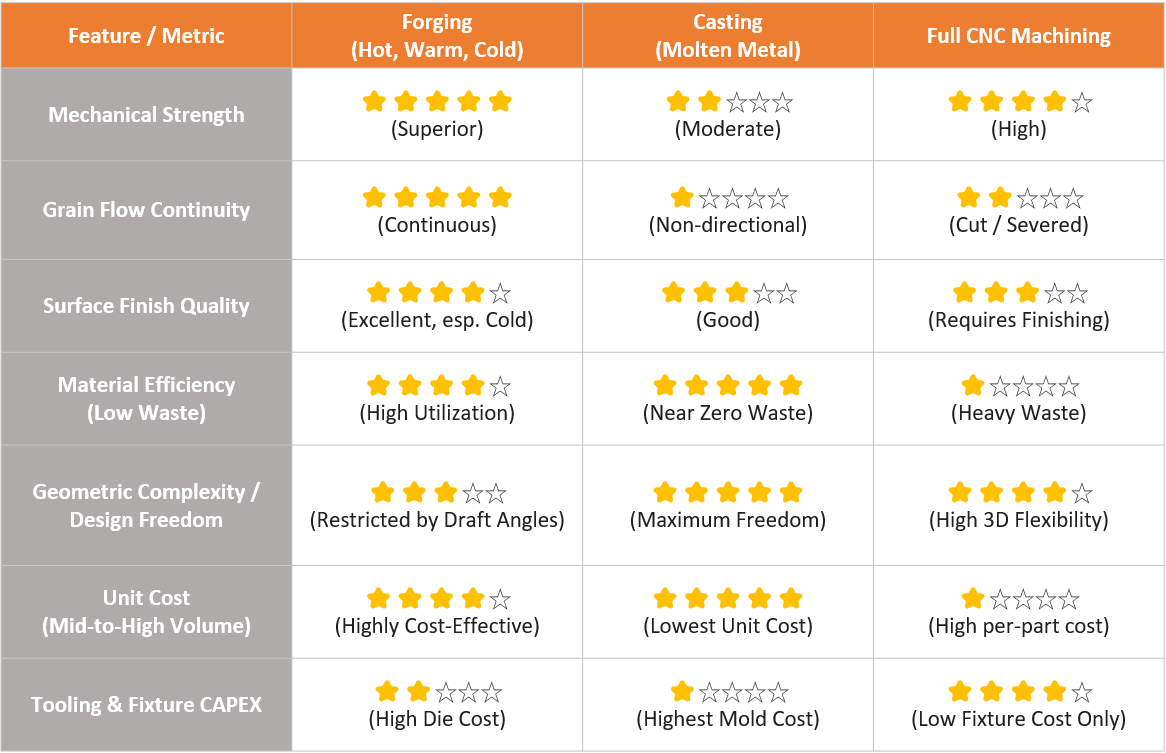
2. Why Forging Outperforms for High-Stress OEM Components
1.Superior Strength-to-Weight Ratio
Because forged aluminum achieves maximum structural density and grain alignment, engineers can design thinner wall sections and lighter components without compromising mechanical safety.
2.Unmatched Structural Reliability (Elimination of Porosity)
In safety-critical applications—such as performance motorcycle swingarms or heavy-duty hand tool handles—internal voids can cause catastrophic brittle fractures. The extreme pressure of forging crushes and seals potential internal micro-voids, delivering superior structural soundness and dependable mechanical reliability.
3.Cost Efficiency in Medium-to-High Volume Production
Machining a part entirely via full CNC results in up to 70%-80% raw material scrap. Utilizing forged blanks shapes the material close to the intended contour, which significantly cuts raw material waste, secondary CNC machining cycle times, and tool wear during volume production.
3. Forging Capabilities at Actionfast
At ActionFast, we specialize in transforming raw aluminum bar stock into high-integrity forged blanks and fully machined finished components. By integrating aluminum Hot, Warm, and Cold Forging with secondary CNC machining, we help OEM clients achieve:
- Optimal parting line design and draft angles for structural strength.
- Efficient blank shaping to reduce post-machining material waste.
- Superior surface finishes and dimensional tolerances (especially with cold forging).
- Strict metallurgical control using 100% traceable imported raw materials.
4.Procurement FAQ: Manufacturing Process Selection
- Q1: When should an OEM buyer switch a component design from casting to forging?
- A: A buyer should transition to forging when the component experiences high dynamic loads, severe cyclical vibration, or impact stresses where structural failure presents a safety hazard. Additionally, if cast parts exhibit high reject rates during post-machining or leak testing due to internal porosity, switching to forged aluminum eliminates structural defects and improves overall production yield.
- Q2: Why do components exposed to repeated vibration and cyclic loads perform significantly better when forged rather than cast?
- A: Forged components achieve superior fatigue strength because the high-tonnage forging process (whether hot, warm, or cold) aligns the aluminum’s internal crystalline grains continuously along the 3D contour of the part (directional grain flow). Cast components, by contrast, possess a random, non-directional grain structure filled with micro-porosity. Under repeated dynamic loads or vibration, these micro-voids in castings act as crack initiation sites, leading to premature fatigue failure.
- Q3: Why is aluminum forging significantly more cost-effective than full CNC machining for volume OEM production?
- A: Full CNC machining from a solid block often generates 70% to 80% in raw material scrap and requires lengthy CNC cycle times per part. In contrast, forging pre-forms the heated aluminum into the main shape using forging dies. The secondary CNC machining then only needs to finish critical functional surfaces and tight-tolerance hole features. For medium to high production volumes, the savings in raw material utilization, machine hours, and reduced tool wear quickly offset the initial forging die cost, resulting in a much lower overall unit price.
Conclusion: Partnering for High-Performance
Forged Solutions
Understanding the fundamental differences between forging, casting, and full CNC machining is crucial for making informed OEM procurement decisions.
By selecting forged aluminum, procurement teams achieve the ultimate synergy of structural safety, lightweight performance, and long-term production economy. At ActionFast, our engineering team supports customers from initial process feasibility and DFM review to forging and final machining—delivering reliable components that exceed international standards.